Textile Manufacturing

Smart Wastewater Management for Textile Processing Industries
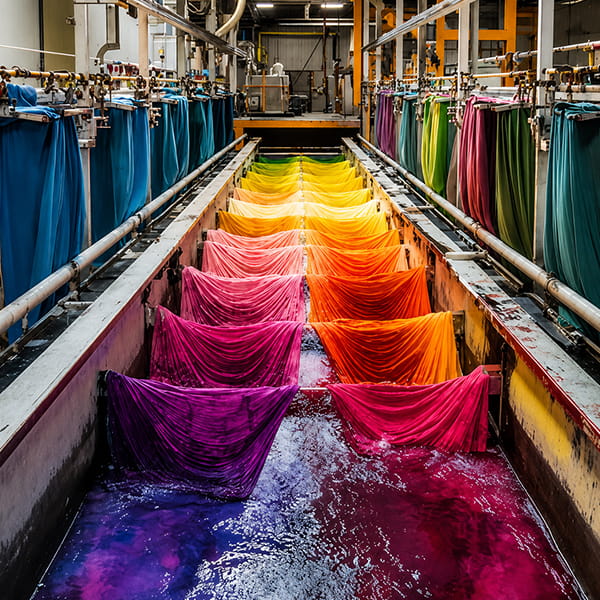
Textile dyeing, printing, washing, bleaching, finishing and water-jet operations consume large quantities of water and generate complex wastewater. Typical pollutants include colour, COD, BOD, dissolved salts, TDS, fibres, suspended solids, dyes, sizing agents, surfactants and process chemicals.
Textile facilities may also generate domestic sewage from employee washrooms, canteens and staff areas. Nitya Ensafe therefore approaches textile water management through an integrated ETP, STP and water-reuse strategy based on the actual manufacturing process and workforce requirements.
Key Wastewater Challenges in Textile Manufacturing
1. Colour from Dyeing and Printing
Residual dyes and pigments can create intensely coloured wastewater and reduce reuse potential. Colour treatment should be selected according to dye chemistry and concentration rather than relying on a standard chemical dose.
2. High TDS and Salinity
Dyeing and wet processing use salts and chemicals that can significantly increase TDS. High salinity can inhibit biological treatment, create scaling and make water recovery more difficult. Segregating high-TDS streams from lower-TDS wastewater may improve treatment efficiency.
3. High COD and BOD
Sizing agents, detergents, surfactants, dyes, finishing chemicals and organic matter can create high COD and BOD. The COD-to-BOD ratio and biodegradable fraction should be evaluated to identify poorly biodegradable compounds, organic shock loads and the required treatment capacity. Depending on biodegradability, the ETP may require a combination of physico-chemical and biological treatment.
4. Water-Jet Wastewater
Water-jet weaving can generate continuous wastewater containing fibres, sizing material, oil, grease and suspended solids. Flow rates and pollutant loading can vary with loom operation and fabric processing. Effective screening, oil and grease separation, equalization and solids removal are important to prevent choking, sludge accumulation and fouling before recycling or further treatment.
5. Chemical Shock to Biological Treatment
Acids, alkalis, bleaching agents, detergents and concentrated process chemicals can create sudden pH or toxicity changes. Equalization, segregation and controlled feeding help protect biological microorganisms from shock loads.
6. Fibres and Suspended Solids
Lint, threads, fibres and sizing residues can block pumps and filters and increase sludge. Proper screening and primary treatment reduce downstream maintenance.
7. Excessive Sludge and High Operating Cost
Overdosing chemicals to remove colour or solids can create large sludge volumes. Inefficient aeration can also increase electricity consumption. Treatment should be optimized to balance colour removal, biological performance, sludge and power use.
8. Industrial Effluent and Domestic Sewage Segregation
Industrial facilities generate domestic sewage and industrial effluent containing chemicals, oils, grease, heavy metals and high COD. Mixing these wastewater streams can disrupt biological treatment, reduce efficiency and cause STP failures. Proper segregation, dedicated STP and ETP systems, suitable pre-treatment and regular monitoring ensure reliable performance, regulatory compliance and safe treated-water reuse.
9. Industrial Effluent & Domestic Sewage Management
Textile factories generate industrial effluent from manufacturing processes and domestic sewage from employees. Mixing these streams without proper assessment can affect treatment efficiency due to their different wastewater characteristics.
ETP is applicable for:
Dyeing, printing, washing, bleaching, finishing, water-jet operations and other wet textile processes.
STP is applicable for:
Domestic sewage generated from employee toilets, washrooms, canteens, administrative areas and worker facilities.
For textile industries with more than 100 employees, STP requirements and treatment capacity should be assessed based on actual sewage generation and applicable regulatory conditions. Proper segregation ensures efficient treatment, regulatory compliance and reliable plant performance.
Nitya Ensafe's Textile ETP Solution
We first study the textile process, chemical usage, water consumption, wastewater sources, dye characteristics, TDS, COD, solids and reuse requirements. The treatment sequence is then designed around these findings.
Our Solutions Can Include
- ETP for dyeing, printing, washing and wet processing.
- Specialized treatment for water-jet wastewater.
- Colour and pigment removal.
- High COD and BOD treatment.
- High-TDS stream management.
- Fibre and suspended-solids removal.
- pH and chemical-shock control.
- Optimized biological treatment.
- Automated dosing and process control.
- Sludge minimization and dewatering.
- Water recovery and reuse systems.
- STP for domestic sewage where applicable.
- Integrated ETP + STP + water-reuse planning.
- Existing ETP upgradation and performance optimization.
- Turnkey execution, commissioning, AMC and O&M support.
Water Recovery and Reuse in Textile Plants
A water-reuse strategy can reduce freshwater demand and wastewater discharge. Depending on required quality, treated water may be considered for selected washing, utility, cooling or other approved applications. Recovery design should account for TDS, hardness, silica, colour and the sensitivity of the final process.
Why Choose Nitya Ensafe?
Textile wastewater changes with fabric, dye chemistry, production schedule and process sequence. Nitya Ensafe avoids one-size-fits-all ETP designs and instead develops a treatment strategy around the actual facility. This helps reduce chemical consumption, sludge, energy use and operator dependency while improving treatment reliability.
Turn Textile Wastewater into a Reusable Resource
The challenge in textile wastewater treatment is not only to reduce one parameter. Colour, salts, organic load, fibres, chemicals and water recovery must be managed together. Nitya Ensafe can evaluate your textile plant and develop a practical treatment and reuse solution for present and future production needs.
Request a Textile ETP and Water-Reuse Assessment
Contact Us →Project Galley

Let’s Build Future Together.