Residential & Commercial

Smart STP Design for Apartments, Townships and Commercial Developments
Residential townships, apartment complexes, commercial buildings, IT campuses, malls, institutions and mixed-use developments generate large volumes of domestic wastewater every day. The most successful projects plan sewage treatment and reuse during the design stage, before utility spaces, plumbing routes and water systems are fixed.
Nitya Ensafe provides customized sewage treatment plant solutions that combine wastewater treatment, water reuse, automation and integration with the wider water-management system. The goal is to deliver stable performance while reducing freshwater demand and long-term operating complexity.
Why Residential and Commercial Projects Need an STP
A properly designed residential sewage treatment plant can help a project:
- Support applicable SPCB/CPCB and local environmental compliance.
- Meet project-specific environmental clearance and approval conditions where applicable.
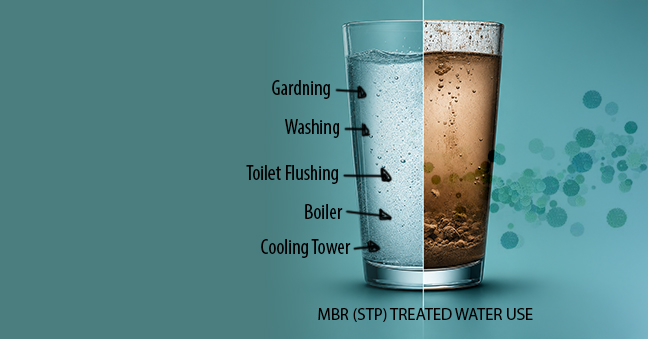
- Recover treated water for flushing, landscaping and selected utility uses.
- Reduce dependence on municipal, borewell and tanker water.
- Support green-building and water-efficiency objectives.
- Reduce wastewater discharge and improve site water balance.
- Maintain reliable operation as occupancy changes over time.
Common STP Challenges in Residential and Commercial Projects
1. STP Planning Starts Too Late
If the STP is considered only after the architectural and MEP layouts are finalized, projects can face incorrect capacity selection, inadequate utility space, poor access and weak integration with reuse plumbing. Wastewater planning should begin with realistic population, occupancy and water-consumption assumptions.
2. Greywater and Blackwater Are Not Properly Assessed
Greywater from bathing and laundry should be tested for ammoniacal nitrogen and organic load rather than assumed to need only filtration. Check collection plumbing for toilet or urinal cross-connections where nitrogen loading is higher than expected. Use screening, equalization and biological treatment suited to the measured wastewater. Where ammonia reduction is required, include nitrification with sufficient aeration, biomass retention, alkalinity and pH control. Nitrification converts ammonia to nitrate; total-nitrogen reduction may also need an anoxic denitrification stage. Provide suitable final filtration and disinfection for the intended non-potable use, with routine ammonia and process monitoring.
3. High TDS from Borewell Water and RO Reject
Conventional biological sewage treatment is not a desalination process. Assess total dissolved solids (TDS) and conductivity in raw water, STP influent and treated water, and identify contributions from RO reject and softener regeneration. Collect concentrated reject separately and evaluate a suitable recovery or disposal route through the site's WTP-RO-STP water balance. Where the intended reuse requires lower salinity, assess additional desalination, such as RO, with suitable pre-treatment and a defined reject-management plan.
4. Inadequate Treated-Water Reuse Planning
An efficient STP creates value only when treated water is actually reused. Missing dual plumbing, undersized storage and poor distribution can lead to continued freshwater use for flushing or landscaping even when treated water is available. Evaluate the treated-water reuse demand for toilet flushing, landscaping and suitable utility applications. Review dual plumbing, storage capacity and distribution arrangements to identify avoidable freshwater consumption. Plan sufficient treated-water storage, pumping and dedicated distribution systems to support consistent reuse. Proper reuse planning significantly reduces fresh water demand & operating cost.
5. Space, Odour and Noise Constraints
Basement plants and compact developments require careful equipment layout, ventilation, acoustic planning and maintenance access. Blowers, pumps and mechanical equipment may require acoustic enclosures, vibration isolators, silencers and suitable positioning to meet site-specific noise limits. Odour extraction and safe access are equally important for resident and tenant comfort.
6. Variable Occupancy and Future Expansion
Townships and commercial developments are often occupied in phases, with changing resident populations, tenant turnover, seasonal use and new towers or commercial blocks. These changes alter average flow, peak hydraulic load and organic loading. Modular treatment trains, flexible aeration and allowance for additional tanks and equipment help maintain performance during initial low loads and future expansion.
7. Floating Scum, Choking and High Maintenance
Investigate recurring scum rather than treating it as routine. Check kitchen oil and grease, aeration, chemical dosing, sludge accumulation and biological performance; surface deposits may include grease, floating solids or biological foam. Provide suitable grease interception, accessible skimming and regular cleaning of screens, scum baffles and collection areas. Review sludge removal, return rates where applicable and aeration using operating data. Avoid indiscriminate chemical dosing; restore stable treatment and confirm outlet quality before returning affected water to reuse.
Nitya Ensafe's Residential & Commercial STP Solution
Our team evaluates the project's wastewater profile, occupancy pattern, collection system, raw-water quality, reuse demand, available space and future development plan before selecting the treatment process.
Key Features
- Customized STP capacity and process design.
- Early-stage wastewater planning for architects, developers and MEP teams.
- Greywater and blackwater assessment where separate systems are proposed.
- Integration of WTP, softener, RO and STP utilities.
- Advanced biological treatment with stable long-term performance.
- Automated operation with reduced manual dependency.
- Compact, space-conscious plant configuration.
- Odour-controlled and low-noise operation.
- Design for variable occupancy and peak hydraulic conditions.
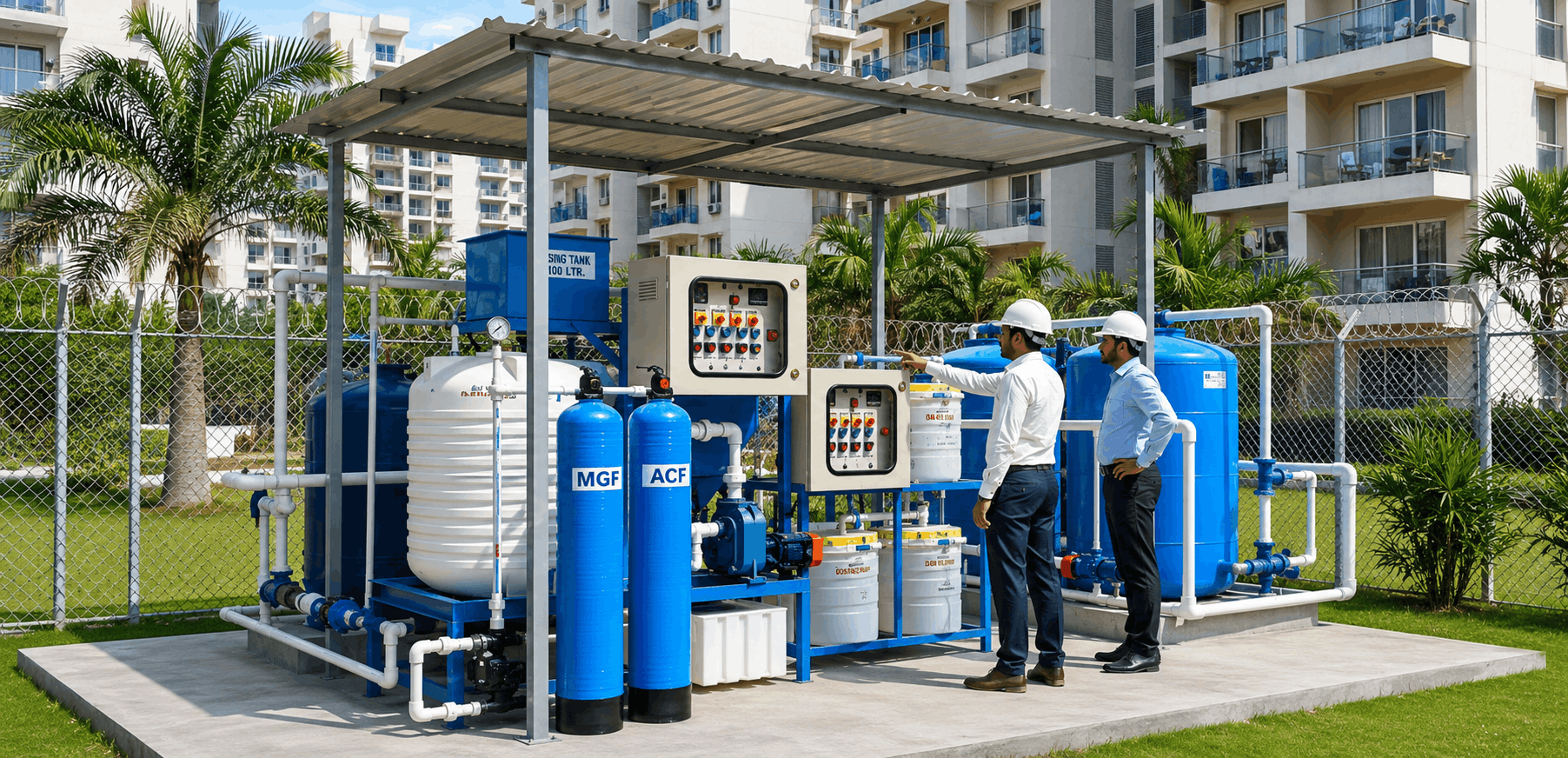
- Tertiary treatment for required reuse quality.
- Energy-efficient equipment and optimized chemical consumption.
- Turnkey execution, commissioning, AMC and O&M support.
Where Treated Water Can Be Reused
Subject to treatment quality and applicable requirements, treated water can be planned for:
- Toilet flushing.
- Gardening and landscaping.
- Cooling and HVAC-related utility uses after suitable polishing.
- Floor and common-area washing.
- Other approved non-potable applications.
A complete reuse strategy should include storage, pumping, dual plumbing, disinfection and regular quality monitoring.
Projects We Can Support
- Apartments and high-rise residential buildings.
- Gated communities and townships.
- Commercial complexes and office buildings.
- Shopping malls and mixed-use developments.
- IT and business campuses.
- Educational institutions.
- Clubhouses and community facilities.
- Existing society STP upgrades and capacity expansion.
Why Choose Nitya Ensafe?
Nitya Ensafe approaches an STP as part of a complete water-management ecosystem. We help project teams coordinate treatment, reuse, plumbing and utility systems from design through commissioning and operation. For existing developments, we can evaluate poor treated-water quality, high power use, odour, excessive chemicals, low reuse and capacity limitations before recommending upgrades.
Plan the STP Before the Problem Starts
The performance of a residential or commercial sewage treatment plant is decided long before commissioning. Early planning, correct wastewater characterization and a practical reuse strategy create a system that is easier to operate, more reliable and better suited to the development's full lifecycle.
Plan Your Residential or Commercial STP With Nitya Ensafe
Contact UsProject Gallery

Let’s Build Future Together.