Where Does Your Wastewater Go? Understanding the Science Behind Sewage Treatment Plants
Water scarcity, stricter environmental regulations, and increasing urbanization are changing how organizations manage wastewater. Today, a Sewage Treatment Plant (STP) is no longer viewed as merely a compliance requirement, it has become a critical infrastructure component for sustainable water management and resource conservation.
Whether for residential townships, hospitals, hotels, educational campuses, commercial developments, or industrial facilities, an efficiently designed STP ensures regulatory compliance while enabling treated water reuse and reducing freshwater dependency.
Understanding Sewage and Its Treatment Requirements
Domestic wastewater primarily originates from toilets, bathrooms, kitchens, laundry facilities, and other sanitary sources. This wastewater contains suspended solids, biodegradable organic matter, nutrients such as nitrogen and phosphorus, pathogens, and traces of chemicals from household activities.
If discharged untreated, sewage can increase Biological Oxygen Demand (BOD) in receiving water bodies, reduce dissolved oxygen levels, and adversely impact aquatic ecosystems and public health.
The objective of sewage treatment is therefore not only to remove pollutants but also to produce treated effluent suitable for discharge or reuse applications.
Key Treatment Stages in an STP
Preliminary & Primary Treatment
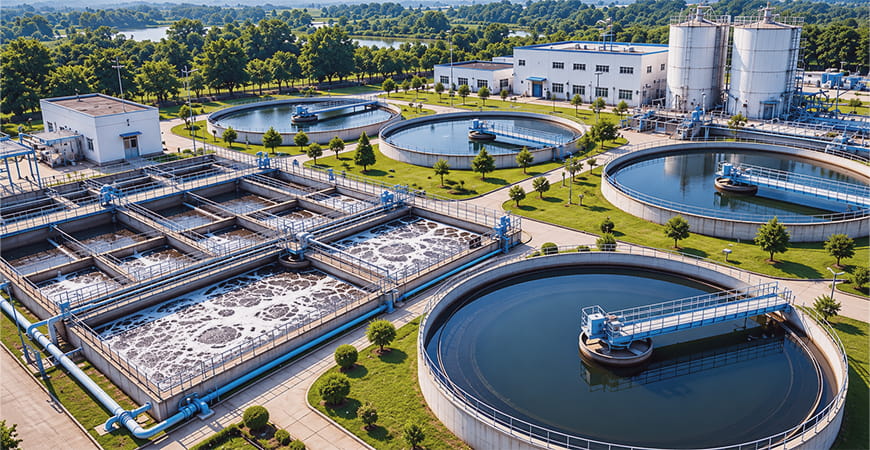
The treatment process begins with screening and grit removal systems designed to eliminate coarse solids, plastics, rags, sand, and other inorganic materials that may interfere with downstream equipment.
Primary settling tanks then facilitate the separation of settleable solids and floating matter such as oil and grease. This stage typically achieves:
- 50–70% removal of Total Suspended Solids (TSS)
- 25–40% reduction in BOD load
Reducing the organic load at this stage improves the efficiency of subsequent biological treatment processes.
Secondary Biological Treatment
Secondary treatment forms the core of any STP.
Biological systems utilize microorganisms to metabolize dissolved and suspended organic pollutants. Depending on project requirements, technologies such as:
- Activated Sludge Process (ASP)
- Moving Bed Biofilm Reactor (MBBR)
- Sequential Batch Reactor (SBR)
- Membrane Bioreactor (MBR)
may be selected.
The choice of technology depends on factors such as land availability, hydraulic loading, influent characteristics, energy consumption, automation requirements, and treated water quality objectives.
A well-designed biological treatment system can achieve BOD and TSS removal efficiencies exceeding 90%.
Tertiary Treatment and Water Reuse
As water reuse becomes increasingly important, tertiary treatment has become an integral component of modern STPs.
This stage may include:
- Pressure Sand Filters (PSF)
- Activated Carbon Filters (ACF)
- Ultrafiltration (UF)
- UV Disinfection
- Chlorination Systems
These processes improve clarity, reduce residual contaminants, and ensure treated water quality suitable for applications such as flushing, gardening, landscaping, cooling towers, and utility services.
Critical Design Considerations
Designing an STP requires more than selecting a treatment technology.
Key engineering considerations include:
- Hydraulic Load Assessment: Accurate estimation of sewage generation based on occupancy, water consumption patterns, and future expansion requirements.
- Influent Characteristics: Analysis of BOD, COD, TSS, nutrient levels, oil & grease, and pH to determine process requirements.
- Land Availability: Space constraints often influence the selection of compact technologies such as MBBR and MBR systems.
- Energy Efficiency: Aeration systems account for a major portion of operational costs. Optimized process design can significantly reduce energy consumption.
- Regulatory Compliance: Effluent quality must comply with CPCB, GPCB, municipal, and project-specific discharge standards.
- Reuse Objectives: The intended application of treated water determines the level of tertiary treatment required.
The Shift Towards Circular Water Management
With growing pressure on freshwater resources, industries and institutions are increasingly adopting a circular water management approach. Treated wastewater is being viewed as a valuable resource rather than a waste stream.
A properly designed STP not only minimizes environmental impact but also contributes to:
- Reduced freshwater consumption
- Lower operating costs
- Improved ESG performance
- Sustainable infrastructure development
- Enhanced environmental compliance
Nitya Ensafe's Approach to Sewage Treatment Solutions
At Nitya Ensafe, we provide end-to-end engineering solutions for sewage treatment, water reuse, and environmental compliance. Our expertise spans feasibility studies, process design, detailed engineering, regulatory approvals, technology selection, turnkey execution, and operational support.
By integrating technical excellence with sustainability objectives, we help organizations develop wastewater management systems that are efficient, compliant, and future-ready.
Because effective wastewater management is not just about treatment,it's about creating long-term environmental and operational value.